

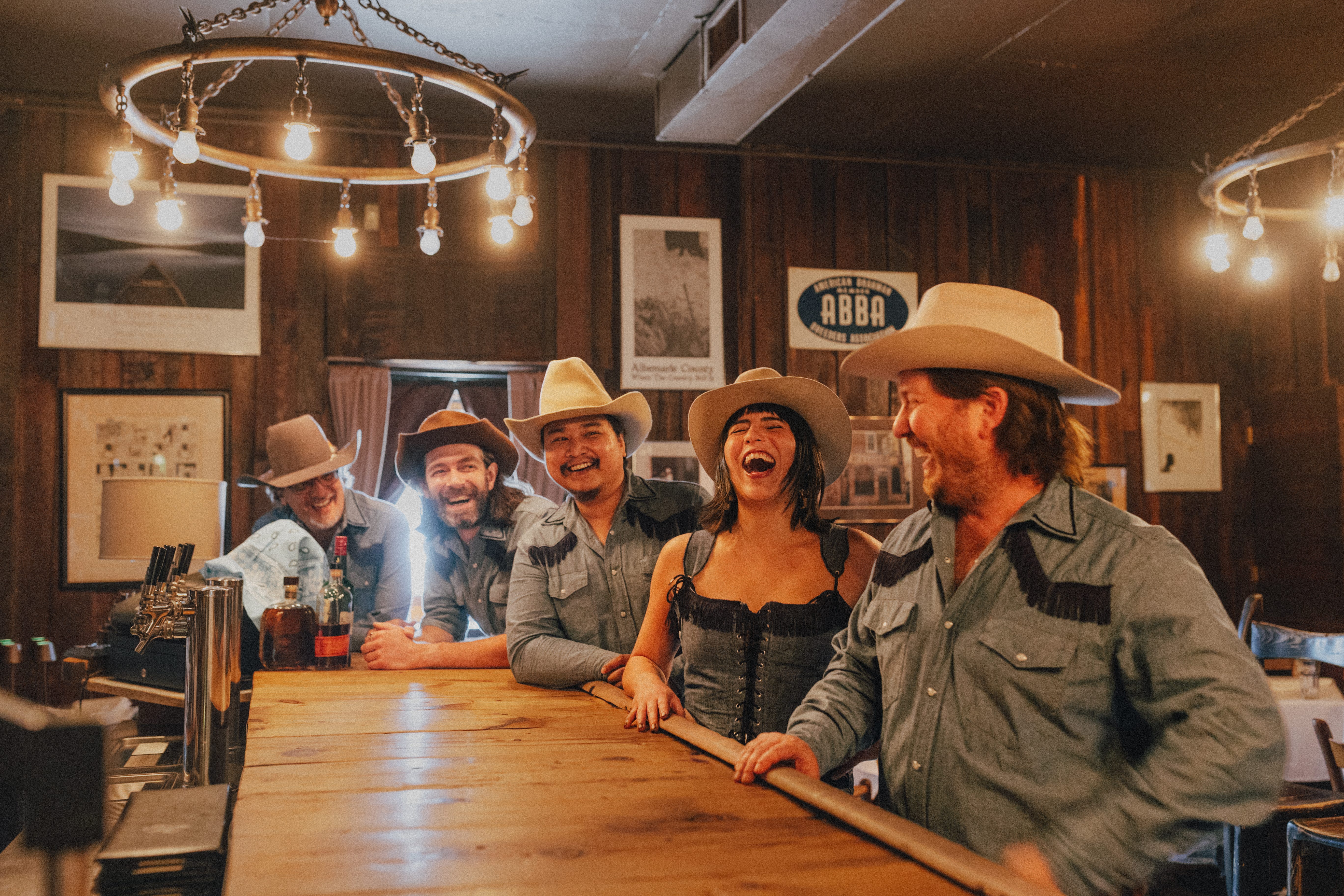
It’s not every day that a band releases their debut album, let alone sees it notch on the Americana charts. So I was thrilled to sit down recently with Ramona Martinez of Ramona and the Holy Smokes, whose self-titled album debuted on September 26 and has been steadily gaining ground ever since. The Holy Smokes - quick round of applause for that band name - blend vintage country and Mexican folk genres to create their unique Latin honky-tonk sound, appropriately dubbed “Mexi-tonk.” Meanwhile, Ramona’s voice is unmistakably contemporary. The band reveres the past without living in it, hitting a sweet spot that just might be timelessness.
We talked tarot, time signatures, folk Catholicism, and what it means to sing in Spanish as a “no sabo” kid with Mexican ancestral roots. We hadn’t scheduled a talk on Dia de los Muertos on purpose. It was just when we had free time. But some conversations happen exactly when they need to.
Rebecca Shields: Congrats on the album! Releasing an album is enough to celebrate, but you’re charting too.
Ramona Martinez: It’s wild.
RS: What is this like?
RM: It’s so cool… Honestly, thank you for saying that. Sometimes, when people ask about the band, it’s like you don’t know how fast you’re going if you’re in the vehicle. It’s sometimes even hard to get a sense of how much distance we’ve covered because we’ve only been a band for three and a half years. So the fact that in three and a half years we have an album out, and our name is even being mentioned in the same breath on the charts as these artists who’ve been doing it for decades…
We have a radio promoter that we hired for three months. She’s really, really good at what she does. She works with all country and Americana artists. I believe the music is certainly strong enough to chart. But if we hadn’t hired her, I don’t know that we would have been on the charts at all.
RS: Your sound is vintage, but with a contemporary point of view. [Pedal steel guitar meets the stark reality of artistic economic precarity in “Down & Out.”] Does having that throwback feel create tension in the digital era?
RM: Totally. The one thing I definitely don’t want as a country artist steeped in the tradition of midcentury country-western music is to sound like a novelty act. Sometimes some of the people in this space can kind of go there, whether it be a country-western accent that’s not real, whether that be production that reads way too 1960s Patsy Cline, Jordanaires. I just don’t feel like that’s what we want to do. The songwriting itself is definitely heavily inspired by those eras. But I don’t sit down to write a Hank Williams song. Everything comes through the lens of my own experience. And something I think is really cool about being any kind of artist is that I think the universe uses us as vessels to transmit art into the world. Through that mystical experience, there’s sort of the anima of all of the music that’s come before, and that gets mixed into it too. I call them my honky-tonk angels.
RS: That connects with the weekend’s focus on ancestry. [We spoke on the Día de Muertos, a holiday dedicated to honoring one’s ancestors that originated in Mexico and is observed in many Spanish-speaking cultures.] How did you get drawn to that vintage sound?
RM: I’ve always loved old music. My parents really instilled me with a love of music from the ‘40s, ‘50s, and ‘60s - everything but country, though! My mom got me really into classic movie musicals from the golden years of Hollywood. And that had so much great songwriting. Cole Porter, all of Gershwin, Sondheim. And I loved the Beatles. My dad was super into Marvin Gaye, Aretha Franklin, the Temptations.
When I started listening to mariachi about three years ago, I just gravitated towards the ‘40s, ‘50s-era, more so than modern stuff. Whenever Latinos hear me play music, they’re always surprised. “How do you know that? That’s old mariachi!” I don’t know if in a past life, I was alive during that period…
RS: There’s something about hearing instruments made from wood, or the texture of that vintage sound. It feels… different emotionally than contemporary recordings.
RM: I didn’t grow up in the States, and so this might be the answer to why I personally like it. I grew up in military, embassy compounds overseas, and so my exposure to American culture was largely through classic films - ‘40s, ‘50s, ‘60s films. That shaped my music taste.
RS: Especially seeing it from abroad.
RM: Exactly. Because you’re not in it. You’re one step removed. And honestly, that’s how I feel about how I ended up writing country music too. I didn’t grow up with it, but I have listened to enough of it to know what’s going on. And Patsy Cline didn’t grow up in Nashville or Austin. She listened to the Grand Ole Opry on the radio. Her early music was super honky-tonk because she knew what it was and could play the style.
That’s something I think people don’t realize about country music history in terms of the debate over authenticity or whatever. Many legends of country didn’t grow up on a farm, weren’t cowboys. I don’t know where that came from.
RS: How did the Holy Smokes come together?
RM: On Christmas Eve 2020, I wrote a country song randomly. About six months later, I channeled a poem, and after that I started writing a lot - about 20 songs in a year. I had a solo show at the end of 2021. My pedal steel player, Brooks Hefner, was there and said, “If you ever want to have pedal steel behind your music, let me know.” I said, “Absolutely.” The band played its first show in April 2022. After some early change-ups, it’s been the same five guys for three years now. The mariachi elements came about a year later.
RS: So you didn’t start as a mariachi-style band.
RM: No. As you can see from our album, we’re really not. We play two [Spanish-language] originals and three Spanish covers. I’m writing more songs in Spanish that I hope to incorporate into the band, so it’s definitely a part of our show. I sing in Spanish better than in English because the vowels are more operatic.
RS: How did this album come together?
RM: We’ve been playing these songs for a long time. We had 30–35 originals to choose from. We wanted variety: slow songs, fast songs, different feels. “Even in My Dreams” is 12/8 swamp pop — more like Freddy Fender or even Patsy Cline.
RS: That’s my favorite on the album. And you do soar in that song vocally as well. It is that sort of operatic sound.
RM: Thank you. And that song almost didn’t make the album!
“Somedays, Sometimes” is countrypolitan, Tammy Wynette-style wall-of-sound with strings, and “1000 Little Heartbreaks” is a straight two-step. And then what if we only make one album? We don’t want to hold back. We’re gonna make the best album we can possibly make.
And then the story of the album was figured out in post [production]. It was pretty clear that my songwriting revolved around some pretty consistent themes. The woman who painted my album cover is a close friend of mine, and I asked her, “Can you please listen to the album and tell me what you think is about?” Are you into tarot at all?
RS: I dabble.
RM: She says, “I think your album is the seven of cups and the eight of cups.” The seven of cups is - you’re kind of captivated by the fantasy, right? And that can be really full of potential, but it also can keep you stuck. And the eight of cups is about walking away from something that is holding you back from your spiritual growth. And like all the songs do this. “Gonna Be Mine” is definitely a seven of cups song. “This Little Heart” is an eight of cups song. “Even in My Dreams” is a seven of cups song. “Esta Herida” is an eight of cups song. “I’m stuck. I don’t know how to get out of this”, or “I’m stuck. I should get out of this. I’m not ready to get out of this” - whether it’s a relationship, drinking, being poor, whatever.
RS: Or holding yourself back? Do you see your story in that as well?
RM: I think “Gonna Be Mine” might be the most thematically connected to that one, because my friend and I wrote it as pure satire, but it actually is like, “Oh yeah. I’m gonna make it. It’s gonna be my life when I do (wink).”
In part 2 of the interview, Ramona and I chat about songwriting influences from the pop and indie worlds, her brand of folk Catholicism, and music as mystic ritual. Part 2 drops later this week.
This interview has been edited and condensed for clarity.